
 Facebook
 X
X
 Pinterest
 Copy Link
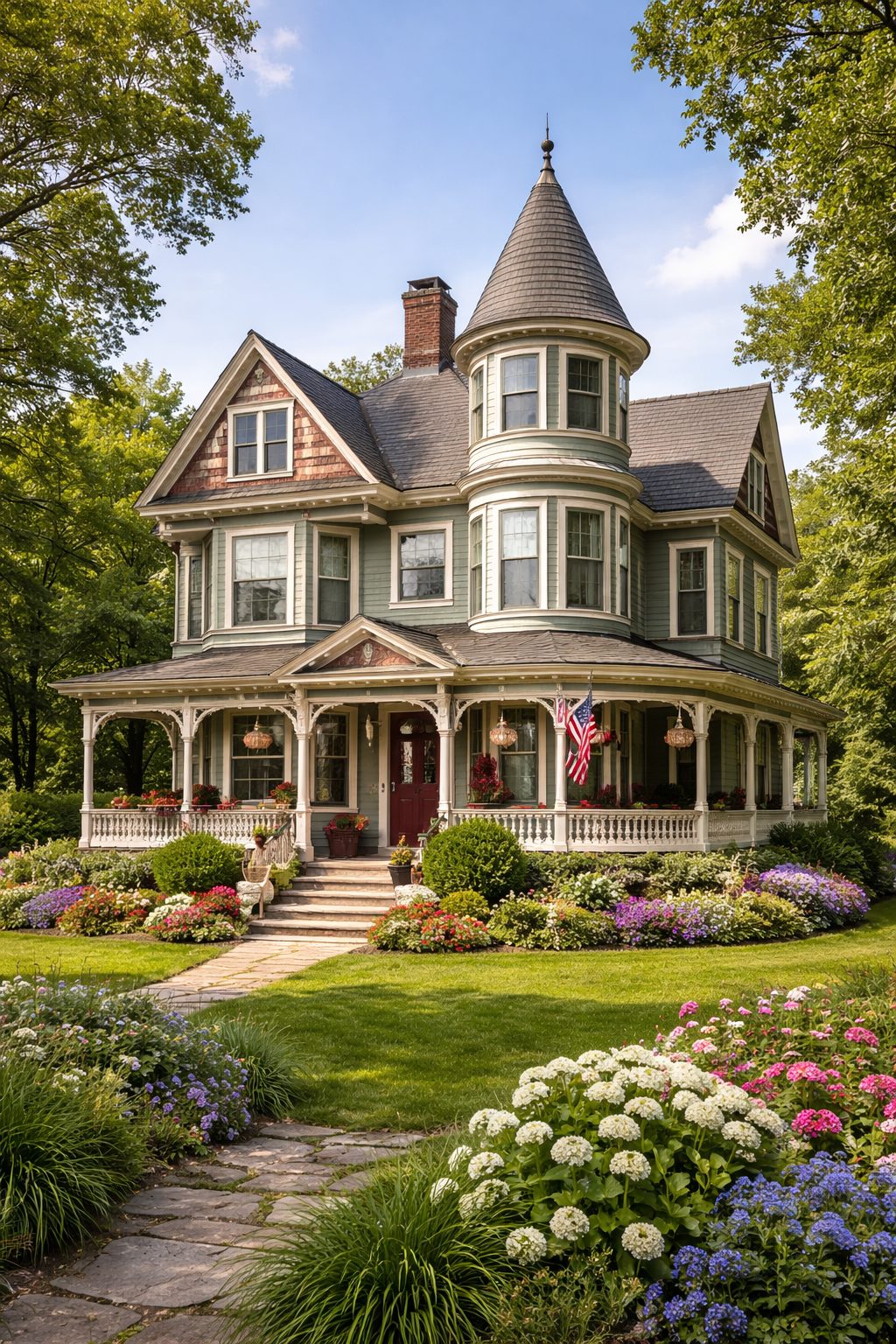
Coastal Connecticut has never been a place that resists change — it has always absorbed it, digested it, and made it its own. The same shoreline that preserves 17th-century Saltboxes and 18th-century Federals has also embraced the exuberant ornamentalism of the Victorian era and the clean-lined pragmatism of contemporary coastal design. Today we explore two architectural styles that bookend the modern history of the Connecticut shore: the spectacular Queen Anne Victorian and the quietly confident Contemporary Coastal home — and we consider how both, in very different ways, speak to the enduring character of this extraordinary place.
Queen Anne Victorian: When the Connecticut Shore Went Spectacular
The decades following the Civil War brought transformative prosperity to the Connecticut shoreline, and with it a new architectural sensibility that was as theatrical and self-confident as the Gilded Age itself. The Queen Anne style — named somewhat misleadingly for the early 18th-century English monarch but inspired primarily by the asymmetrical, richly ornamented domestic architecture of the English Arts and Crafts movement — arrived in America in the 1870s and swept through coastal Connecticut with remarkable speed and enthusiasm. Here was an architecture that made no apologies for ornament, complexity, or display.
In Mystic, the Queen Anne tradition left a vivid imprint on the residential neighborhoods that grew up around the shipbuilding yards during the town’s 19th-century peak. The elaborate turned porch posts, decorative spindlework friezes, steeply pitched multi-gabled roofs, projecting bay windows, and richly textured wall surfaces — combining clapboard, patterned shingles, and decorative woodwork in a single composition — can still be seen in the older residential streets of Mystic Village and the surrounding neighborhoods of Groton and Stonington.
Stonington Borough’s Victorian-era architecture tells a slightly different story — one of a community that was by the late 19th century shifting from active maritime commerce toward a new identity as a place of summer leisure and cultural distinction. The grand summer cottages built by prosperous New Haven, Hartford, and New York families along the Borough’s outer streets drew on Queen Anne vocabulary — the asymmetrical massing, the wraparound piazzas, the multiple gables and towers — but softened it with Shingle Style informality, producing a distinctly Connecticut coastal vernacular that remains enormously appealing today.
Venture slightly inland to Putnam, Willimantic, and the mill towns of northeastern Connecticut, and the Queen Anne tradition takes on a harder, more urban character — the style was equally popular for the grand houses of mill owners and industrialists who built in the region’s manufacturing centers. But it is along the coast, in communities like Old Lyme, Madison, Clinton, and Westbrook, where the Queen Anne style found its most poetic expression — homes whose elaborate ornamental facades seem in perpetual conversation with the energy and restlessness of Long Island Sound visible just beyond the front porch.
Caring for a Victorian Home on the Connecticut Coast
Queen Anne and Victorian homes along the Connecticut shoreline present their owners with a particular set of maintenance and preservation challenges — and a particular set of rewards. The elaborate millwork that defines these homes — the turned balusters, the sawn decorative trim, the ornamental vergeboard — requires regular inspection and repair, and the multi-gabled rooflines with their complex valleys and intersections demand careful attention to flashing and drainage. The coastal environment compounds these challenges: salt air accelerates paint failure, persistent moisture promotes wood rot, and the freeze-thaw cycle of New England winters tests every joint and connection. But the homeowners who commit to the care of these buildings are rewarded with properties of extraordinary character and enduring market value. In a shoreline real estate market where truly distinctive historic homes are in finite supply, a well-maintained Queen Anne in Mystic or Stonington commands a premium that reflects both its architectural irreplaceability and its deep emotional resonance.
Contemporary Coastal Architecture: Honoring the Shoreline Through Modern Design
A different but equally compelling vision of the Connecticut shore has emerged over the past three decades in the form of Contemporary Coastal architecture — a design approach that is neither nostalgic nor indifferent to history, but that seeks a new synthesis between the practical demands of 21st-century coastal living and the enduring character of the New England shoreline landscape. These are homes that take FEMA flood elevation requirements as a design opportunity rather than a constraint, that use natural materials like cedar, ipe, zinc, and stone in ways that respond honestly to the coastal environment, and that organize their interiors and exteriors to maximize the extraordinary visual and sensory experience of living by the water.
Along the Connecticut shoreline from Greenwich to Stonington, a new generation of Contemporary Coastal homes has been reshaping the residential landscape. In communities like Old Saybrook — where the Connecticut River meets Long Island Sound in one of the most scenically dramatic settings on the New England coast — new construction has increasingly embraced elevated forms, standing-seam metal roofs, generous covered outdoor living spaces, and large expanses of glazing oriented toward the water. These homes are practical in the face of a changing coastal environment: elevated on piers or concrete foundations to meet modern flood requirements, clad in materials that require minimal maintenance, and designed with mechanical systems and building envelopes that can withstand the demands of a coastal climate far more effectively than the historic homes they sometimes replace.
In the neighborhoods surrounding Mystic and Stonington, Contemporary Coastal design has found particular traction in the infill and teardown market — older seasonal cottages on prime waterfront lots being replaced by year-round homes that reflect both the aspirations of their owners and the realities of modern coastal living. The best of these new homes are not indifferent to their context: they borrow from the Shingle Style tradition a sense of informal materiality and a willingness to let the building’s exterior weather naturally into its surroundings; they borrow from the Colonial tradition a respect for scale, proportion, and the relationship between solid and void; and they bring to both a contemporary commitment to environmental performance and spatial generosity that historic forms alone could not provide.
Neighboring communities like North Stonington, Ledyard, and Preston — slightly removed from the immediate shoreline but deeply connected to it culturally and economically — are also seeing increasing interest in Contemporary Coastal design principles, as buyers seek the aesthetic and practical qualities of shoreline architecture in more affordable inland settings. The language of cedar and glass and standing seam metal, of elevated decks and generous overhangs and carefully composed views, has proven remarkably adaptable to a range of sites and contexts along the broader southeastern Connecticut coast.
The Best of Both Worlds: Designing in Context
At Shutters & Sails, we believe that the most successful contemporary coastal homes are those that take their context seriously — that understand the visual and cultural history of the Connecticut shoreline and find ways to honor it without being enslaved by it. A new home in Stonington does not need to be a Victorian pastiche to feel at home in its neighborhood; it needs to be thoughtfully proportioned, honestly detailed, and genuinely responsive to its site. A renovation of a Queen Anne in Mystic does not need to freeze the house in amber; it can introduce contemporary systems and spatial thinking while respecting the integrity of the historic fabric. This is the creative territory we inhabit every day, and it is the work that drives our passion for coastal Connecticut architecture.
From the elaborate gingerbread porches of a Victorian in Groton to the clean cedar-clad lines of a new coastal home rising above the salt meadows of Old Lyme, the architecture of the Connecticut shore is a living, evolving story — one that we are proud to help write. Shutters & Sails works with homeowners throughout coastal Connecticut, from Greenwich to Stonington and all the remarkable communities in between. We would love to hear about your project. photo credit: open ai


