
 Facebook
 X
X
 Pinterest
 Copy Link
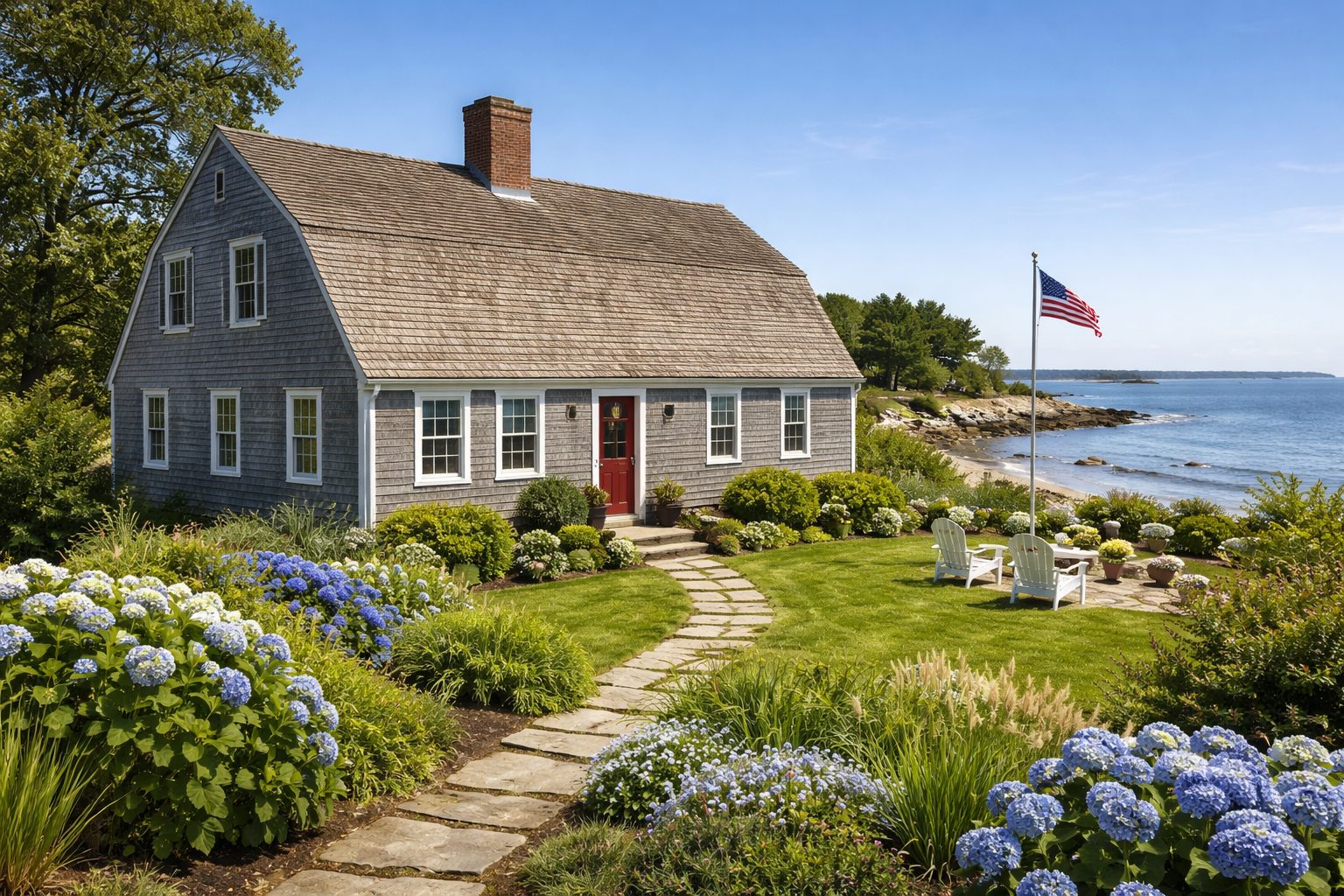
There is a particular quality of light on the Connecticut shoreline in the early morning — the way it catches the clapboard facades of a centuries-old home on a harbor street in Stonington, or illuminates the fanlight above a doorway in one of Mystic’s historic neighborhoods — that makes you feel the weight and depth of the region’s architectural heritage in a visceral way. The homes of coastal Connecticut were not designed by architects in the modern sense. They were built by craftsmen working within living traditions, solving real problems of climate, material, and way of life. The Saltbox and the Federal style house represent two distinct moments in that story: the practical ingenuity of the earliest settlers, and the refined cultural aspirations of a young republic coming into its own.
The New England Saltbox: Pragmatism as Poetry
The Saltbox is perhaps the most distinctly New England of all residential architectural forms — and it came about not through deliberate design, but through the practical necessity of expansion. The earliest Colonial homes built in coastal Connecticut were typically one or one-and-a-half stories, organized around a central chimney. As families grew and prosperity allowed, additions were made to the rear of the house. Rather than raising the roofline of the addition to match the original structure, builders would extend the existing rear roof slope downward, sometimes nearly to the ground, creating the dramatically asymmetrical profile that gives the Saltbox its name — a silhouette that recalls the wooden salt boxes once hung in colonial kitchens.
In Guilford, Connecticut — one of the oldest towns on the shoreline and home to the Henry Whitfield State Museum, the oldest stone house in New England — the Saltbox tradition is particularly well preserved. The Thomas Griswold House, built around 1639, is one of the finest surviving examples of the form in America, its long sweeping rear roofline a testament to generations of piecemeal addition and pragmatic adaptation. Walking through Guilford’s historic Green district is like reading a primer in early New England domestic architecture: Saltboxes, center-chimney Colonials, and early Georgian forms line the streets in a remarkably intact streetscape.
Move east along the shoreline toward Old Lyme and East Haddam, and the Saltbox continues to appear — sometimes in its original 17th-century vernacular form, sometimes in later interpretations that borrowed the silhouette for new construction. The form proved remarkably well-suited to the Connecticut climate: the long rear slope deflected prevailing winter winds, the extended rear addition provided sheltered workspace, and the massive central chimney kept the entire house warm with a single fire. In towns like Lyme, Salem, and Colchester — slightly inland but deeply tied to the coastal economy through the Connecticut River trade — the Saltbox became the defining domestic form of the 17th and early 18th centuries.
Even in Stonington and Mystic, where later architectural fashions eventually supplanted the Saltbox, you can still find examples tucked along back roads and in older residential neighborhoods — homes that predate the Federal period, their humble asymmetrical profiles a reminder of how this coast was first settled and how its earliest families actually lived.
Building on the Saltbox Tradition
For contemporary homeowners drawn to the Saltbox’s evocative silhouette and deep historical roots, the form offers surprising flexibility. Modern interpretations of the Saltbox — sometimes called ‘contemporary Saltbox’ or ‘updated Colonial vernacular’ — preserve the dramatic asymmetrical roofline while incorporating open floor plans, large glazed rear walls that take advantage of the long rear slope, and all the amenities of 21st-century living. In communities like Lyme, Old Lyme, and the quieter residential areas of Stonington Town, new construction Saltboxes blend seamlessly with the historic fabric of their surroundings while offering thoroughly modern interiors.
Federal Style Architecture: The Connecticut Coast Comes of Age
If the Saltbox was the architectural vernacular of survival, the Federal style was the architectural language of aspiration. Flourishing in the decades following American independence — roughly 1780 through 1830 — the Federal style was a deliberate statement of cultural confidence, drawing on the neoclassical ideals of ancient Rome and Greece as interpreted by the British architects Robert Adam and his followers. It arrived on the Connecticut shoreline at a particularly propitious moment: the post-Revolutionary period coincided with a golden age of maritime commerce, and the prosperous sea captains, merchants, and lawyers of coastal Connecticut were eager to build homes that announced their standing in a new, self-governing republic.
Stonington Borough is one of the finest concentrations of Federal architecture in coastal New England. The Borough’s compact streetscape — largely unchanged since the early 19th century, when Stonington was a prosperous whaling and sealing port — is lined with Federal-period homes whose refined details speak to the wealth and sophistication of their original owners. Elliptical fanlights above paneled front doors, delicate pilasters flanking the entry, attenuated window proportions, low-pitched roofs with decorative cornices, and interior plasterwork of extraordinary fineness — these are the marks of the Federal style as practiced by the master builders of Stonington in its heyday.
In Mystic, where the shipbuilding industry would reach its peak in the 1850s, Federal-period homes can be found in the older sections of the village — the neighborhoods that predated the great mid-century expansion. The Mystic River corridor preserves a number of significant Federal-era structures that speak to the town’s early history as a maritime community of real ambition and cultural aspiration.
East toward Watch Hill in Rhode Island and west toward New London and Groton, the Federal tradition connects coastal Connecticut to a broader New England architectural story. New London in particular — just across the Thames River from Groton — preserves a significant collection of Federal-era commercial and residential architecture that testifies to the city’s importance as a whaling port and commercial center in the early 19th century.
Federal Style Details Worth Preserving
The Federal style’s most defining characteristic — and its most fragile — is its extraordinary attention to decorative detail at human scale. The elliptical fanlight above the door, the delicate leaded sidelights, the reeded pilasters and dentilled cornices, the six-over-six windows with their thin glazing bars — these are elements that were handcrafted by skilled joiners and plasterers working in a tradition that has largely disappeared from American building practice. For homeowners in Stonington, Mystic, and the surrounding communities who are fortunate enough to own Federal-period homes, preserving these details is both a practical investment and a cultural responsibility. At Shutters & Sails, we work with preservation specialists and skilled craftspeople who understand the Federal tradition from the inside out, and we are passionate about helping our clients maintain these irreplaceable architectural assets.
Whether you own a Saltbox on a quiet lane in Lyme, a Federal-period captain’s house in Stonington Borough, or a property that sits in the shadow of these great traditions, Shutters & Sails is here to help you understand, preserve, and celebrate what you have. Reach out to our team to begin the conversation.
Photo Credit: open ai


